|
|
Front cover:
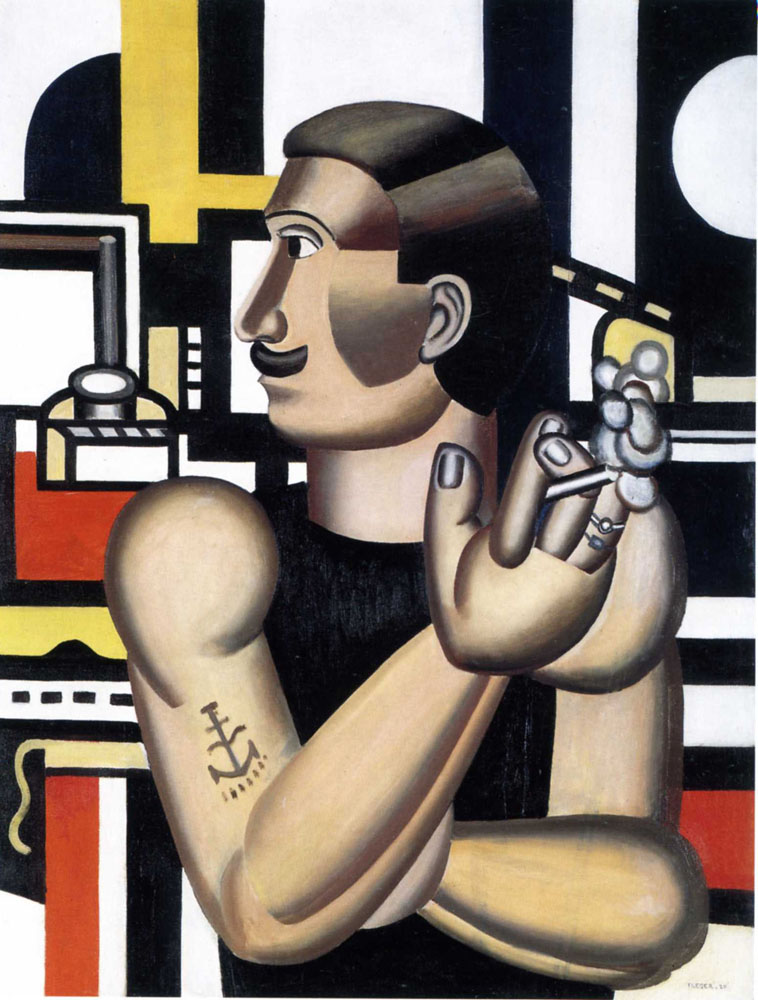
The Mechanic - Fernand Leger 1920 National Gallery of Canada - Ottowa
PAINTING IN SLANG Léger, an exact contemporary of Picasso
and Braque, started off experimenting with cubism but gave it up
following his experiences in the first world war. He forgot the
abstraction of 1912-13 because of the “crudeness, variety, humour,
and downright perfection of certain men around me, their precise
sense of utilitarian reality and its application in the midst of the
life-and-death drama we were in ... made me want to paint in slang
with all its colour and mobility."
In
1945, he joined the Communist Party. During this period his work
became less abstract, and he produced many monumental figure
compositions depicting scenes of popular life featuring acrobats,
builders, divers, and country outings. Art historian Charlotta Kotik
has written that Léger's "determination to depict the common man, as
well as to create for him, was a result of socialist theories
widespread among the avant-garde both before and after World War II.
However, Léger's social conscience was not that of a fierce Marxist,
but of a passionate humanist"
He wrote in 1945 that "the object in modern painting must
become the main character and overthrow the subject. If, in
turn, the human form becomes an object, it can considerably liberate
possibilities for the modern artist." He elaborated on this idea in
his 1949 essay, "How I Conceive the Human Figure", where he wrote
that "abstract art came as a complete revelation, and then we were
able to consider the human figure as a plastic value, not as a
sentimental value. That is why the human figure has remained
willfully inexpressive throughout the evolution of my work"
|