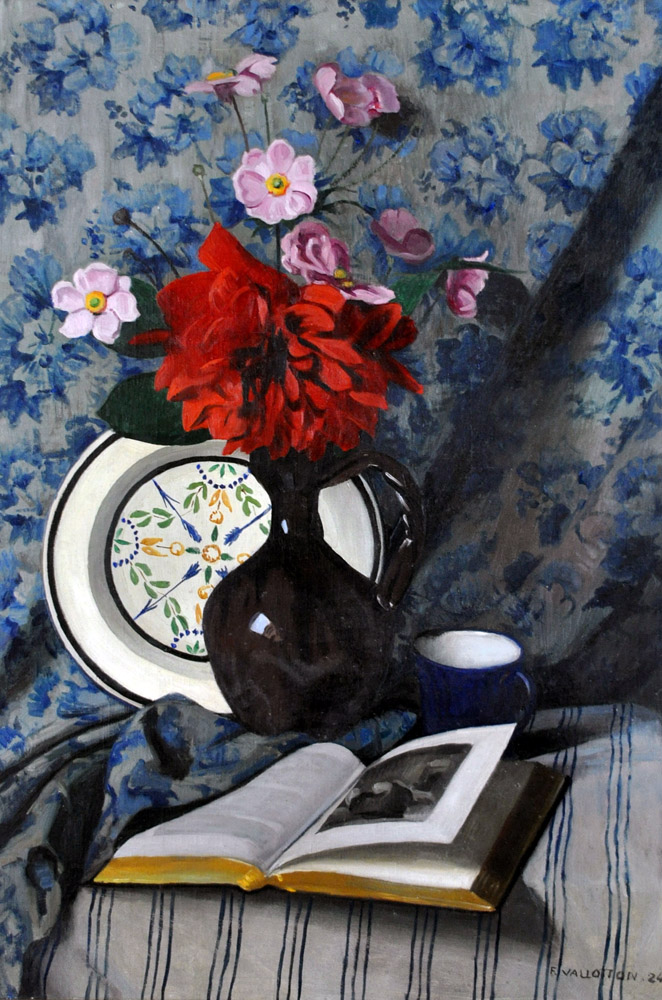
Front cover: Dahlias
Rouge et Livre Ouvert
Félix Vallotton 1924
Musee d’art moderne Troyes
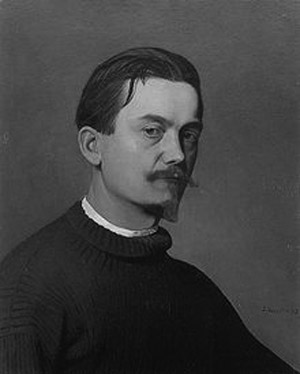
Félix
Vallotton
By the end of the 19th
century, Paris
was the unrivalled capital of the Western art world.
Impressionism had transformed the visual arts, and
Post-Impressionism was flourishing in its wake. Meanwhile, new
boulevards and parks had modernised the medieval city, while
theatres and department stores provided endless opportunities
for entertainment and consumption. Artists, alongside scientists
and industrialists, were seen by many as the leaders, the
avant-garde, of a new society.
Into this dynamic
world arrived the 16-year-old Swiss artist, Félix Vallotton, who
would make Paris
his home for the rest of his life. He became closely involved
with a group of artists known as Les Nabis, which
included Pierre Bonnard and Edouard Vuillard, adopting their
decorative painterly language and sharing their interest in
journalistic illustration and Japanese ukiyo-e prints.
Offering witty and often unsettling observations of domestic and
political life,
Vallotton’s woodcuts were frequently
published in the press and he is now
considered one of the
greatest printmakers of his age. As his work evolved, the sharp
realism and cool linearity of his later style – drawn from such
sources as Holbein and Ingres – made him one of the most
distinctive artists of the early 20th century.
This is the first
comprehensive survey of Vallotton’s career to be held in the UK.
Through more than 80 paintings and prints, we explore an
extraordinary body of work: from compelling portraits, magnetic
still-lifes, luminescent landscapes and bitingly satirical
prints, to interior scenes which reverberate with psychological
tension.
Often anticipating the
emotionally charged paintings of Edward Hopper and the films of
Alfred Hitchcock, these works demonstrate a legacy of vision
that
carried into the 20th century.
Blurb on the forthcoming
Royal
Academy of Arts exhibition
June-Sept 2019