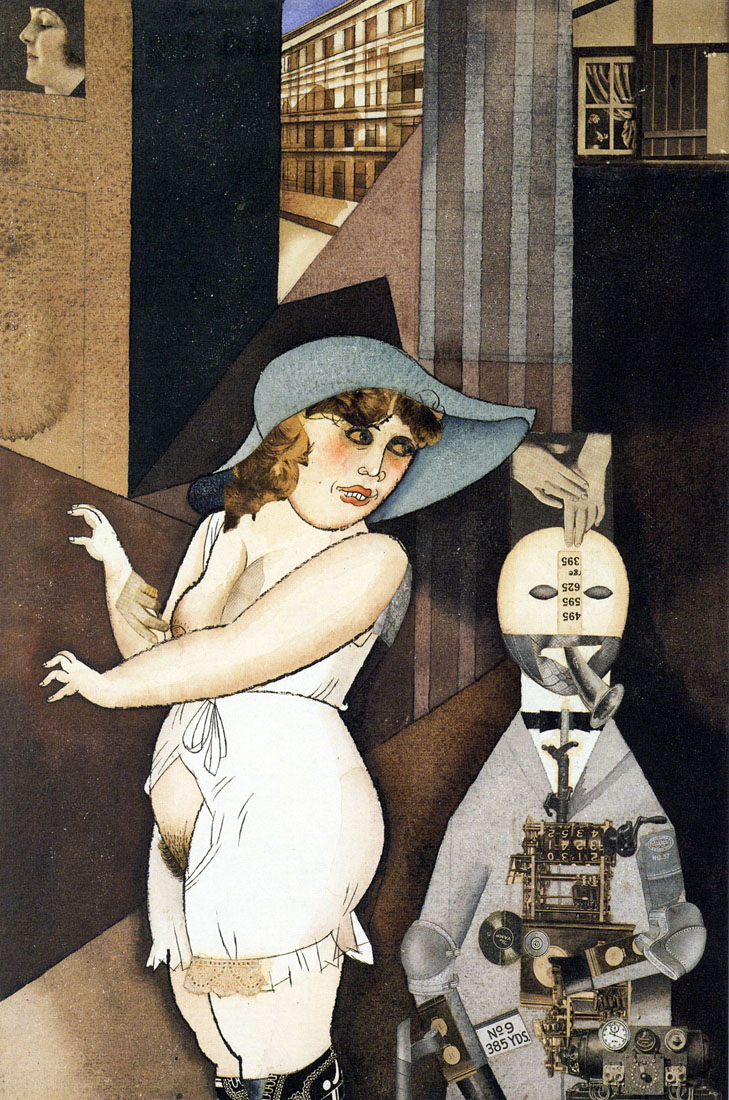
Front cover: Daum marries
her pedantic automaton George in May 1920
John Heartfield is very glad of it –
George Grosz
Berlinischer Gallerie
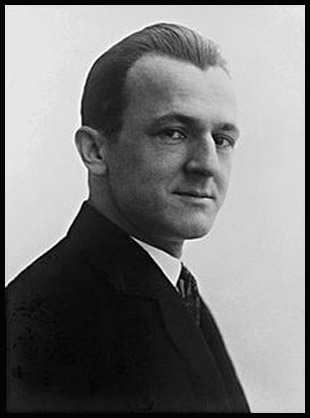
In the last months of 1918, Grosz joined
the Spartacist League. He was arrested during the Spartakus
uprising in January 1919, but escaped using fake identification
documents. In 1921 Grosz was accused of insulting the army,
which resulted in a 300 German Mark fine and the destruction of
the collection Gott mit uns ("God with us"), a satire on German
society. In 1928 he was prosecuted for blasphemy after
publishing anticlerical drawings, such as one depicting
prisoners under assault from a minister who vomits grenades and
weapons onto them, and another showing Christ coerced into
military service. Grosz publicly stated that he was neither
Christian nor pacifist, but was actively motivated by an inner
need to create these pictures, and was finally acquitted after
two appeals. In 1922 Grosz travelled to
Russia
with the writer Martin Andersen Nexø. Upon their arrival in Murmansk they were briefly arrested as spies;
after their credentials were approved they were allowed to meet
with Grigory Zinoviev, Anatoly Lunacharsky, and Vladimir Lenin.
Grosz's six-month stay in the Soviet Union
left him unimpressed by what he had seen. He ended his
membership in the KPD in 1923, although his political positions
were little changed.
Bitterly anti-Nazi, Grosz left Germany shortly
before Hitler came to power. In June 1932, he accepted an
invitation to teach the summer semester at the Art Students
League of New York. In October 1932, Grosz returned to
Germany, but on January 12, 1933, he and
his family emigrated to the United States. Grosz became a
naturalized citizen of the U.S.
in 1938, and made his home in Bayside,
New York. In the 1930s he taught at the
Art Students League, where one of his students was Romare
Bearden, who was influenced by his style of collage. He taught
at the Art Students League intermittently until 1955.
In America, Grosz determined to make a
clean break with his past, and changed his style and subject
matter. He continued to exhibit regularly, and in 1946 he
published his autobiography,
A Little Yes and a Big No.
In the 1950s he opened a private art school at his home and also
worked as Artist in Residence at the
Des Moines
Art Center.
In 1954 he was elected to the
American
Academy of Arts and
Letters. Though he had U.S.
citizenship, he resolved to return to
Berlin, and relocated there in May 1959.
He died there on July 6, 1959, from the effects of falling down
a flight of stairs after a night of drinking.