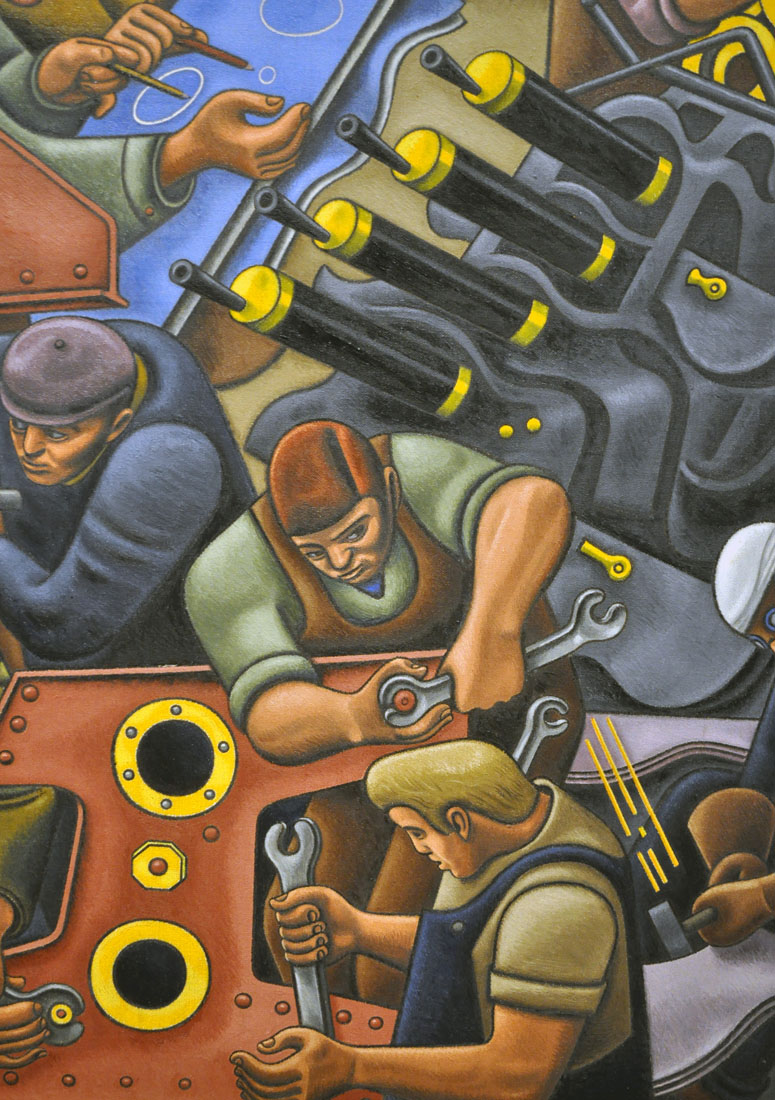
Front cover: Munitions
Factory 1940
William Roberts

Self Portrait
Wearing a Cap 1931
Roberts
was born into a working-class family in
London's
East End on 5 June 1895. The family were then
living at 44
Blackstone Road
in Hackney, and his father was a carpenter. From an early age
Roberts showed an outstanding talent for drawing. He left school
at the age of 14 and took up an apprenticeship with the
advertising firm of Sir Joseph Causton Ltd, intending to become
a poster designer. He attended evening classes at Saint Martin's School of Art
in London
and won a London County Council scholarship to the Slade School
of Art . He joined the Slade in 1911, studying under Henry Tonks
and Wilson Steer. His contemporaries at the Slade included Dora
Carrington, Mark Gertler, Paul Nash, Christopher Nevinson,
Stanley Spencer, David Bomberg and Bernard Meninsky. The Slade's
emphasis on the importance of drawing and sound structuring of
composition would inform Roberts's later work.
Roberts was intrigued by
Post-Impressionism and Cubism, an interest fuelled by his
friendships at the Slade (in particular with Bomberg) as well as
by his travels in France
and Italy
after leaving the Slade in 1913. Later in 1913 he joined Roger
Fry's Omega Workshops. After leaving Omega he was taken up by
Wyndham Lewis, who was forming a British alternative to
Futurism. Ezra Pound had suggested the name Vorticism, and
Roberts's work was featured in both editions of the Vorticist
literary magazine BLAST. Roberts was a signatory to the
Vorticist Manifesto that appeared in the first edition of the
magazine. Roberts himself preferred the description "Cubist" for
his work of this period.
Roberts was often described as reclusive,
and he was very wary about interviewers – especially after an
Observer journalist who visited him produced an article that
Roberts felt was concerned more with his rather Spartan
lifestyle than with his work.
"What kind of art critic is this, who sets out to
criticise my pictures, but criticises my gas stove and kitchen
table instead?" he asked.
Roberts developed a highly personal
style of portraiture. The format increasingly favoured by the
artist was head and shoulders. This allowed him to concentrate
on the face and exclude any surrounding details which might be
distracting. In 'Self
Portrait Wearing a Cap' Roberts depicts himself in a shirt,
wearing braces, tie and a flat cap. He thus identified himself
as a working man, a persona he projected in later self-portraits
of the 1950s and 1960s.