|
|
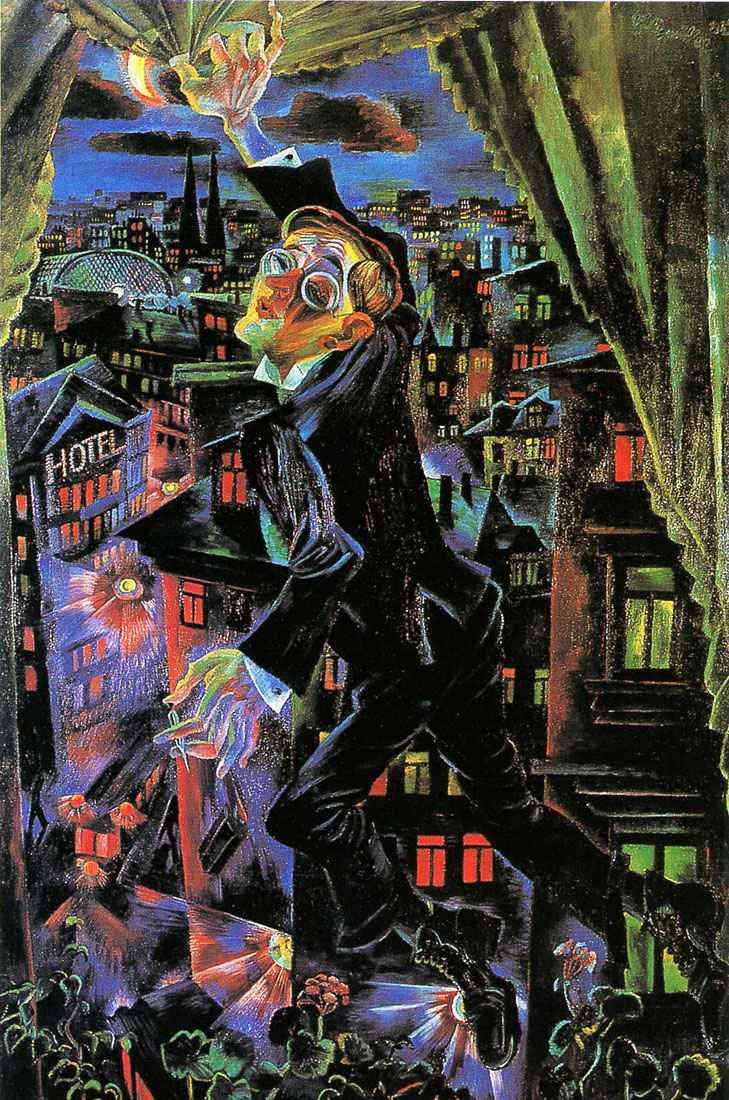
Cover: Death of the Poet Walter Rheiner 1925 – Los Angeles County Museum
The outbreak of war in 1914 was to be Felixüller's most
significant experience, one which shaped his artistic attitude
for the rest of his life. From the very beginning he felt
revulsion towards the events of the time, and he was one of the
few people who refused to join in the patriotic war euphoria.
Felixmüller also began to think of his art as a form of
political commitment.
In 1915 he travelled to Berlin, where he met a number of people
who became important for his further work. He joined Pfemfert's
circle of artists and writers. In his magazine, Pfemfert took an
uncompromising stand against the bourgeoisie and militarism,
while at the same time rejecting any form of aestheticism.
Through him, Felixmüller met Meidner, Raoul Hausmann, Grosz,
Herzfelde and the poet Theodor Daubler, who had similar artistic
and political views.
Felixüller's pictorial idiom drew upon two artistic sources.
While in Dresden, the
Brücke
artists - even though they had been unable to influence official
art - left their mark on the young Felixmüller. His formal
repertoire, on the other hand, benefitted from the achievements
of Cubism. But although Felixmüller never gave up the unity of
space in his paintings, he simplified the motifs by composing
them from angular, block-like shapes. "Without being a
'Cubist'," he said, "I imposed the form of nature on the basic
shape, on 'absolute form'.".
Felixmüller's art is never impartial. His pictures always
express solidarity with the harsh living and working conditions
of the common people, particularly miners. In this he was closer
to Dix for a while - whose friendship he enjoyed for a brief
period - than Grosz with his political agitation.
Workers on Their Way
Home
of
1921 and
Factory Workers in the Rain
(1922) as well as
Death of the Poet Walter Rheiner
are
typical examples of Felixüller's Expressionist paintings. When
Felixmüller was offered a scholarship in Rome in 1920, he
decided to study the heavily industrialized Ruhr area instead.
He was also actively involved in the German Communist Party. In
the mid-twenties, however, he realized that his revolutionary
aims had failed and therefore changed his artistic style. His
expressive distortions and harsh colours disappeared and were
replaced by a Naturalist concept of space and more restrained
colours. The private subjects, which had always been present in
his politically committed work, now came to the fore.
Expressionism
Diemar Elger
|