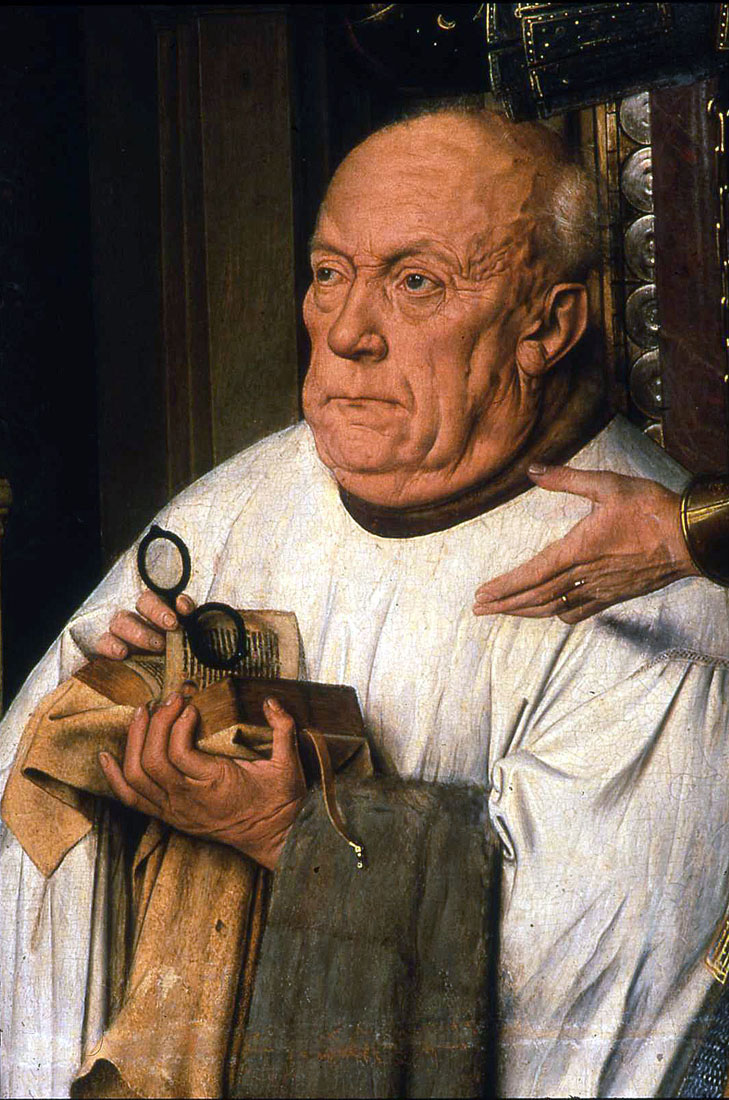
The Canon looks like a classic bookworm. He could be
squinting
disdainfully at the Crazy Oik and trying
to decide whether it should be on the index. Van Eyck’s
realism is so freakishly accomplished you could almost
figure out the prescription of his specs – looks like a
mild case of presbyopia. But with the bins on he could
probably do brain surgery on a gnat. The nearest great
Van Eyck would be the Arnolfini Wedding in the National
Gallery – a favourite of the oiks. But Bruges isn’t that
far away. You could easily whizz over to the Groeningen
and stand gobsmacked in front of that huge five foot
wide canvas
Otto Dix (featured on several Oik covers) was a fan. In
reaction against German Expressionism he was a follower
of the Neue
Sachlichkeit (New Realism).
Considered revolutionary
within his lifetime, van Eyck's designs and
methods
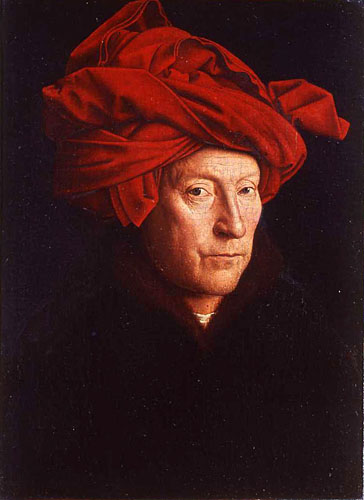
were heavily copied and reproduced. His motto, one of
the first and still most distinctive signatures in art
history, ALS ICH KAN ("AS I CAN"), a pun on his name
first appeared in 1433 on Portrait
of a Man in a Turban, which can be seen as
indicative of his emerging self-confidence at the time.
The years between 1434 and 1436 are generally considered
his high point when he produced works including the Madonna
of Chancellor Rolin, Lucca Madonna and Virgin
and Child with Canon van der Paele.