|
|
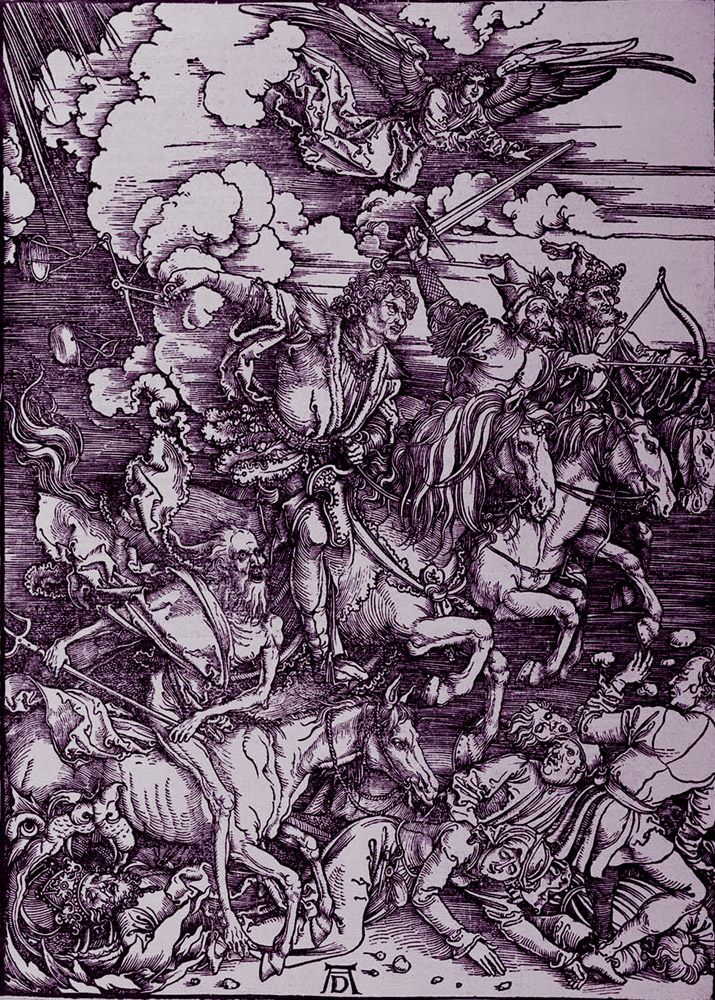
Cover: Four Horsemen of the Apocalypse –
Albrecht Durer
Durer used the subject of the four horsemen— who are given the
power to kill a fourth of mankind with sword, with hunger, with
death, and with the beasts of the earth—to make the famous
representation of destruction passing over the earth like a
storm. German art up to then has nothing that can be compared to
this effect of movement. Durer brought the four figures, who
appear in the text one after the other and had never before been
shown as one group, closely together. He lifted them up in the
air and thus gained a number of corresponding, fantastic
movements. At that time he was not yet entirely capable of
representing a horse, let alone a horse in movement, but he
worked with suggestive effects of lines which made more perfect
drawing superfluous.
These horses do not gallop equally
well, and in the case of the panting, scrawny horse of Death the
laboured movement is even intentional; but the main motif, the
rider who leans forward in the saddle and swings the scales in
his lifted hand like a hunting whip, has a fine, powerful
movement. The animals make big strides; their hind legs are not
visible and this greatly adds to the effect. All four horsemen
look into the distance, none at the nearest object. They form a
chain which goes through the whole picture and completely
crushes everything on the ground. This too is new. In older
representations usually only a small heap of people were shown
in front of Death. On the lower left is the mouth of Hell,
and rays of light are seen in the top left corner. An angel with
mighty wings accompanies the group (it is the angel, carrying a
crown, who is poised originally over the first horseman); a
white cloud rises steeply like a column of dust raised by the
strong beat of hooves. But the atmosphere of the sheet is
determined above all by the vehement collision of light and
shade and the general linear commotion at the edges of the
clouds, the fluttering saddle-cloths, garments, manes and tails.
There is a trembling and roaring in the air.
|