|
|
Mad Meg - Breugel
The
Mad Meg
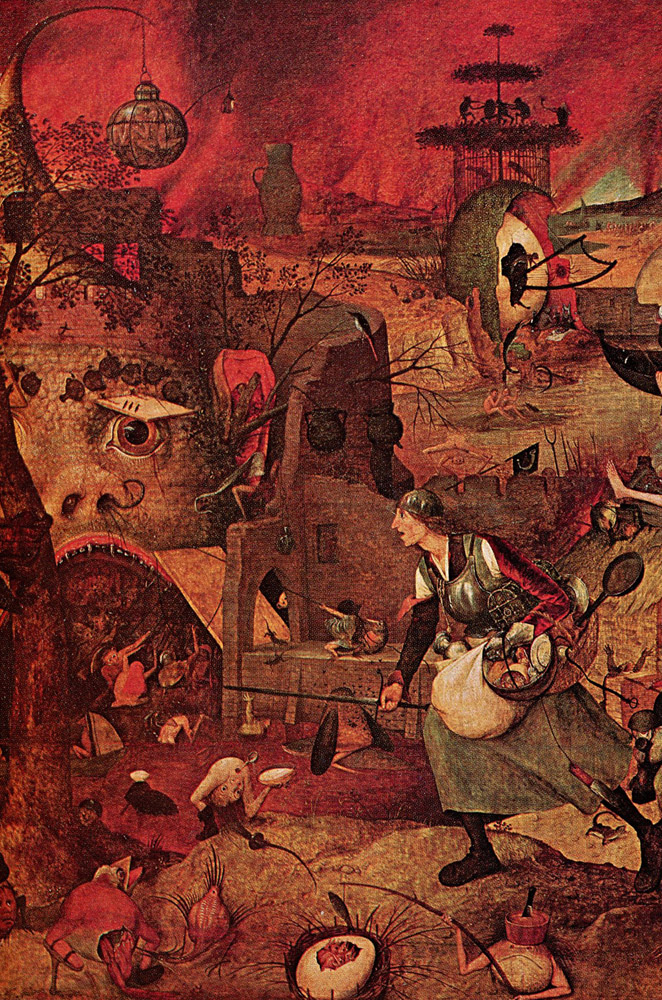
is perhaps the most Boschlike composition by Bruegel, at least
at first glance; there are monsters, demons, a wild
melee
of ruins, ships, weird towers and caves, and conflagrations,
wherever you look. But the resemblance fades somewhat as one
observes more closely. First of all there is a truly predominant
figure, the Dulle Griet
or Mad Meg, who strides forward to the left with a powerful gait
quite alien to Bosch's imagination. She is worse than Hell
itself; in fact, she has just emerged from Hell
victorious,
laden with loot, and is going after other conquests which we can
only imagine. While other, minor hags crowd the bridge which Mad
Meg has just left behind, in a wild contest for the coins that a
truly Boschlike monster sitting on the roof of a house shovels
down to them from his behind, Mad Meg strides on in contemptuous
isolation, with the wild stare of the true fanatic, armed for
combat, a formidable shrew, who has reduced the monsters of Hell
to puny little nincompoops brandishing their armour in
pathetically harmless gestures. She is greed personified, a
truly capital sinner, but in contrast to the designs in which
Bruegel had just previously represented each capital sin in
similarly predominant figures (in the series of the "Vices"),
she is anything but an allegory.
Beside greed, many other sins populate this Hell. The meaning of
some of the monsters, animals, birds, and objects is just as
difficult to identify as it is in paintings by Bosch, but
gluttony, vanity, and un-chastity are more or less clearly
characterized. Most impressive is Bruegel's vision of Satan as
an enormous whalelike demon, still reminiscent of the
traditional "Mouth of Hell" but now conceived as an impassive
tool rather than a violent agent of destruction—so impassive and
stupid in fact that its horrible face and horrified eye have
themselves become the victim of a special brand of parasites.
This concept had already been fully developed in a composition
known to us from Bruegel's original drawing in the Ashmolean
Museum, Oxford and from an engraving of 1556 published by
Hieronymus Cock, strangely without Bruegel's name
Here that huge, stupid head is supposed to frighten Saint
Anthony out of his wits, but is doomed to impotence as are all
his ludicrous companions; it is invaded by parasites as woefully
as is its counterpart in the Mad Meg which is equally ignored by
the main actor in that composition.
The Boschlike character of the picture is quite evident from the
detail; its monsters and its magnificent coloristic use of the
conflagration are familiar from the older master's
representations of Hell, particularly of that on the right wing
of the
Haywain
triptych in the Prado in Madrid. But everything has taken on a
new element of vigour and sturdiness under Bruegel's hands which
perhaps cannot vie with the poetic charm and frailty of Bosch's
interpretation, but produces a level of reality which fits the
different character of Bruegel's entire picture to perfection:
the more three-dimensional forms of the buildings and other
objects such as the big bowl with the soldiers, the bell and the
flag, the soldiers themselves and the monsters, make them appear
more absurd, more foolish than any of Bosch's, and more
appropriate to the protagonist of the painting, which is, after
all, not Satan but Mad Meg.
Wolfgang Stechow
Breugel Abrams
|