|
|
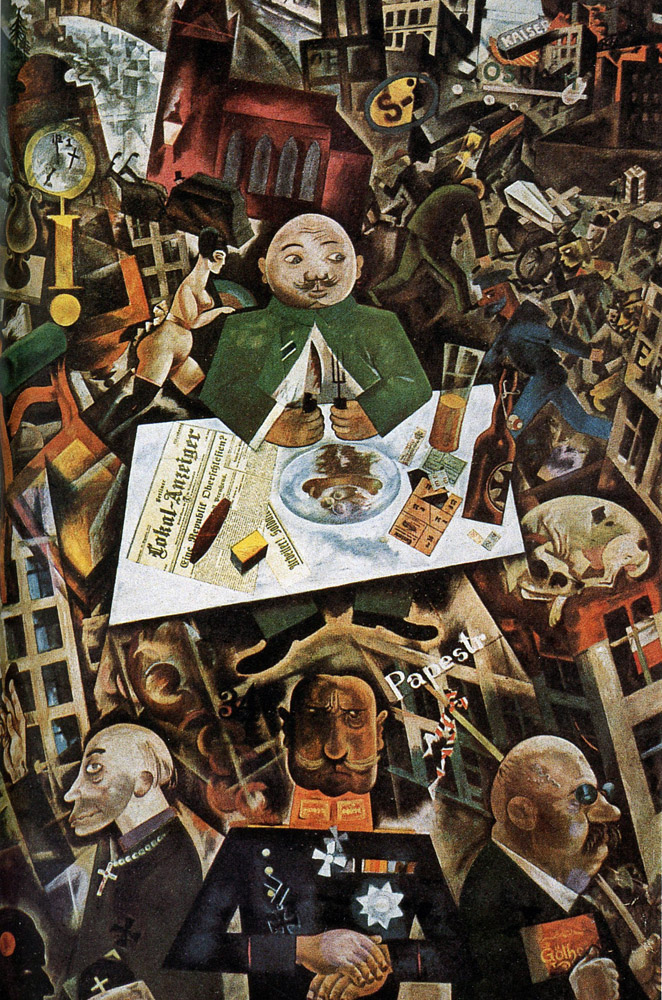
Grosz's
Germany: A Winter's Tale
was painted from 1917 to 1919. (The title was taken from the
poet Heinrich Heine, "Deutschland.
Ein Wintermarchen".) It is widely considered one of the
seminal works in 20th-century socio-critical art. In the
middle of the picture, surrounded by the familiar turmoil of
city chaos, sits a rotund philistine clutching his knife and
fork, gaping with bewilderment. Before him is a plateful of
gnawed bones and a bottle of beer with the Iron Cross on the
label. These, and his cigar and newspaper, satisfy the good
citizen's needs. Below we see the triumvirate that
underwrite his society: the priest, the general and the
teacher, the last puffy-cheeked and bulbous-nosed,
double-chinned and thick-necked, cane in hand and a volume
of Goethe held
to his breast. Grosz returned to the subject of this lower
part of the painting in his 1926
Pillars of Society.
At the bottom left, an adumbrated profile of the artist
appears in silhouette, jaw out-thrust in fury.
Count Harry Kessler, a diplomat and patron of the arts of
whom Grosz wrote in his autobiography that he was perhaps
the last true gentleman, left a diary with a vivid account
of the period. On 5 February 1919, Kessler recorded his
impressions of the painting and of Grosz: "This morning
visited the painter George Grosz in
Wilmersdorf (Nassauische Strasse 4). Wieland and
Hellmuth Herzfelde there. Grosz had a big political
painting,
Germany: A Winter's Tale,
poking fun at the ruling classes, the pillars of the
well-fed indolent bourgeoisie (bolster). He said he would
like to be the German Hogarth, deliberately concrete and
moral; to preach, ameliorate, reform. [...] Then Grosz said
that art as a whole was unnatural anyway, an illness; the
artist was obsessed, a man possessed of a mania. The world
did not need art, he said; people could get by without art."
Kessler describes Grosz a Bolshevik of art, nauseated by
painting, concluding: "In fact his thinking is in part
rudimentary, in terms of its intellectual substance, and
easy to contest."
|