|
|
While it is
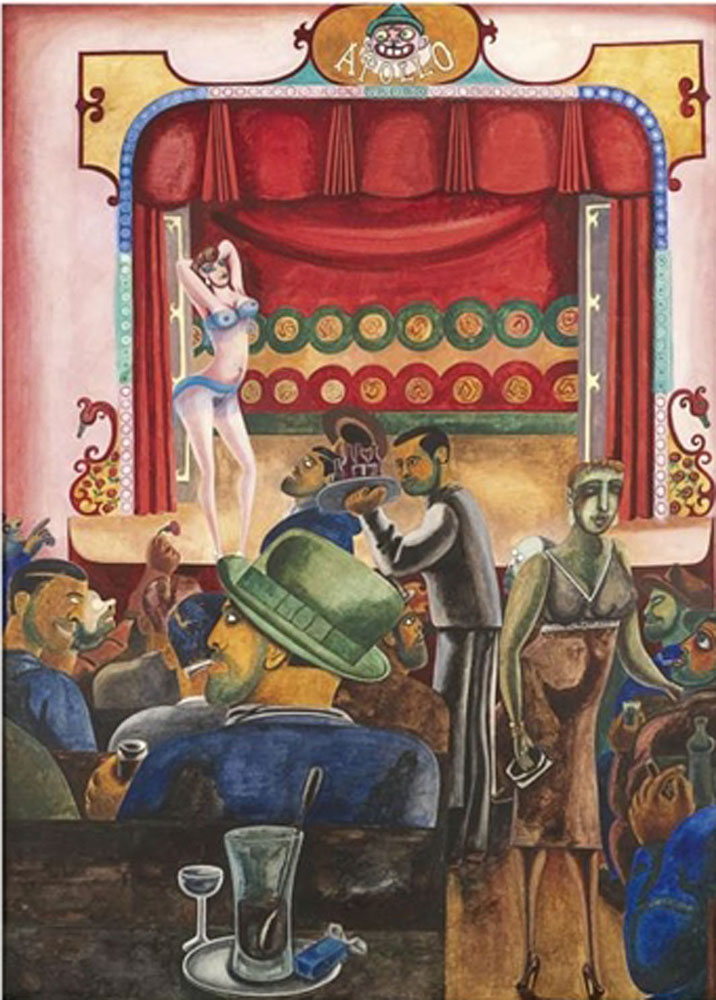
true that Burra was always drawn to places where transgressive
sexualities flourished – clubs, cafés, anonymous street corners
– he himself remained, camera-like, a non-participating
observer. The thousands of letters Burra wrote to his close
friends, now archived at the Tate, may bounce along in high camp
style – men are routinely referred to as "she", and everyone is
"dearie" – but it remains essentially a textual performance.
Burra was happy to label himself a sexless creature. The only
time he admitted to an erection – a weak one at that – was while
watching a film of
Mae West. The counterweight to all this filthy
talk was, incongruously, daily life in Rye, East Sussex, 30 or
so miles up the coast from Chichester. The wealthy Burras were
happily above all that. Their handsome mansion was surrounded by
11 buffering acres and they were too secure to worry about what
the neighbours thought. Nonetheless Burra knew enough of what he
called "Tinkerbelle Towne" and its twitchy inhabitants to want
to poke fun. Although Burra will probably always remain best
known for his early images of city life, his painting continued
to develop throughout his career. As the 30s darkened, he
followed the example of his beloved Goya and
painted the cruelty of war, especially the tragedy of turning
innocent young men into killing machines. He produced a series
of powerful paintings in which diggers, lorries and tractors
morph into monsters ripping through the landscape with a hungry,
polluting lust. By the time he produced these works,
Burra's own horizons had shrunk. Following the death of his
mother in the 1960s, he moved into a small cottage in the
grounds of the family home. His sister came in every day and
there were occasional motoring holidays around Britain with
Billy Chappell, during which Burra would periodically stiffen,
and fix an image on his all-seeing eye. He continued to be
obsessed with his work to the exclusion of all else, explaining
in a rare moment of candour that the only time he was not in
pain was when he was painting. In a filmed interview given
towards the end of his life, Burra declared, or rather drawled,
"I think you ought to work, to paint. Otherwise, if you don't do
enough painting, what's the point of it all?" He died in 1976 at
the age of 72 having lived far longer – and triumphantly – than
anyone could possibly have predicted.
Kathrine Hughes – The Guardian
Nov 2011
|