|
|
Cover:
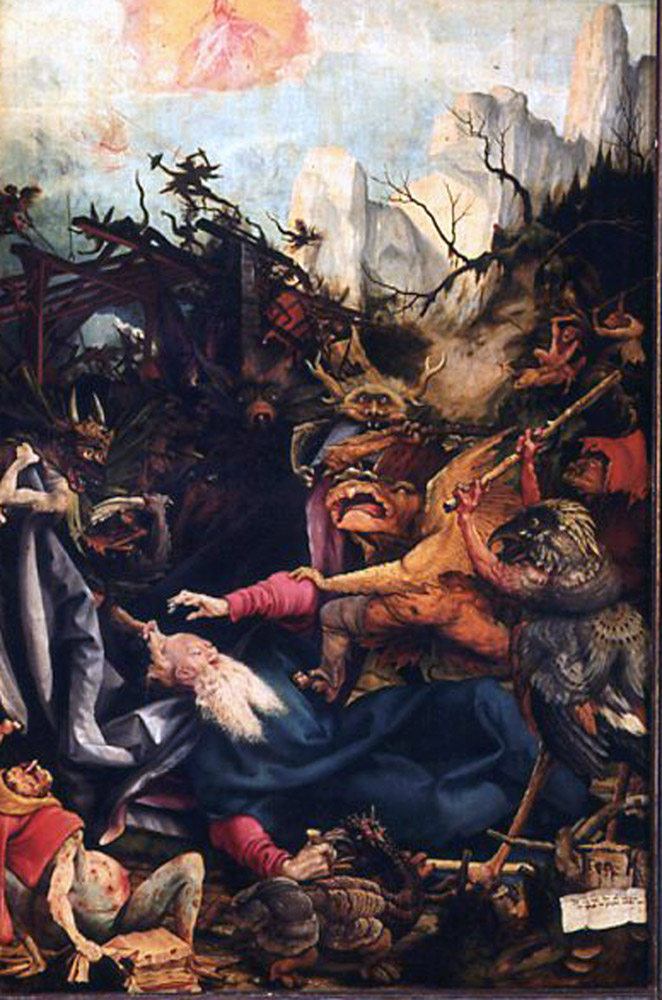
Saint Anthony
Tormented
by Demons
from
the Isenheim
Altarpiece
Colmar
Matthias
Grunwald
1480
-1528
This panel depicts Saint Anthony being tormented by monstrous creatures sent by Satan. Trampled to the ground, beaten with sticks, torn by claws and bitten, Saint Anthony appeals to God for help who sends angels to combat these evil demons. In the lower left corner, the being with webbed feet and a distended belly seems to personify the disease caused by ergot poisoning, resulting in swelling and ulcerous growths. Expressionism covered a multitude of styles, but in general it was characterised by a direct rendering of emotions and feelings. Line, form and colour were used for their expressive possibilities, instead of being primarily representational. Grünewald and his Altarpiece, with its strong association with violent sensation and emotion, therefore became a natural source of inspiration for many Expressionist artists. While Expressionism had always had some level of involvement with social issues, this became acute in the mid-1920s with the development of the Neue Sachlichkeit (New Objectivity), which added a bitter, satirical, sometimes crude and almost caricaturist element. This proved to be far more confronting to the authorities. Although the Constitution guaranteed freedom of expression, the Criminal Code forbade the publication of obscene or indecent writings or illustrations. With some artists, the government appears to have embraced this power with some enthusiasm, confiscating a wide range of material that it deemed unacceptable.
Just
such
an
artist
was
George
Grosz.
He
felt
that
the period
he was
living
in
was
a
transitional
one,
similar
to
that
of the
Middle
Ages,
and
saw his
own art
as being
similar to
the
“moral
criticism
and Jeremiah-
like
art of
Bruegel,
Bosch
and
Grünewald”. A
copy
of
Grünewald’s
Crucifixion actually
hung
on
his studio
wall.
Grosz,
a
veteran
of World
War I,
considered
that
contemporary
artists
should
adapt
the
old
images
and symbols
(such
as
the
Crucifixion) and
invest
them
with
references to
the
political
and
ideological
struggles of
the
20th
century.
His
deliberately-provocative
works,
designed
to
highlight
what
he
saw as
the decadence
of German
society,
brought
him into
constant
difficulties
with
the
authorities,
and
he
had
early
convictions
for
defaming
the
military,
and
obscenity.
|