|
|
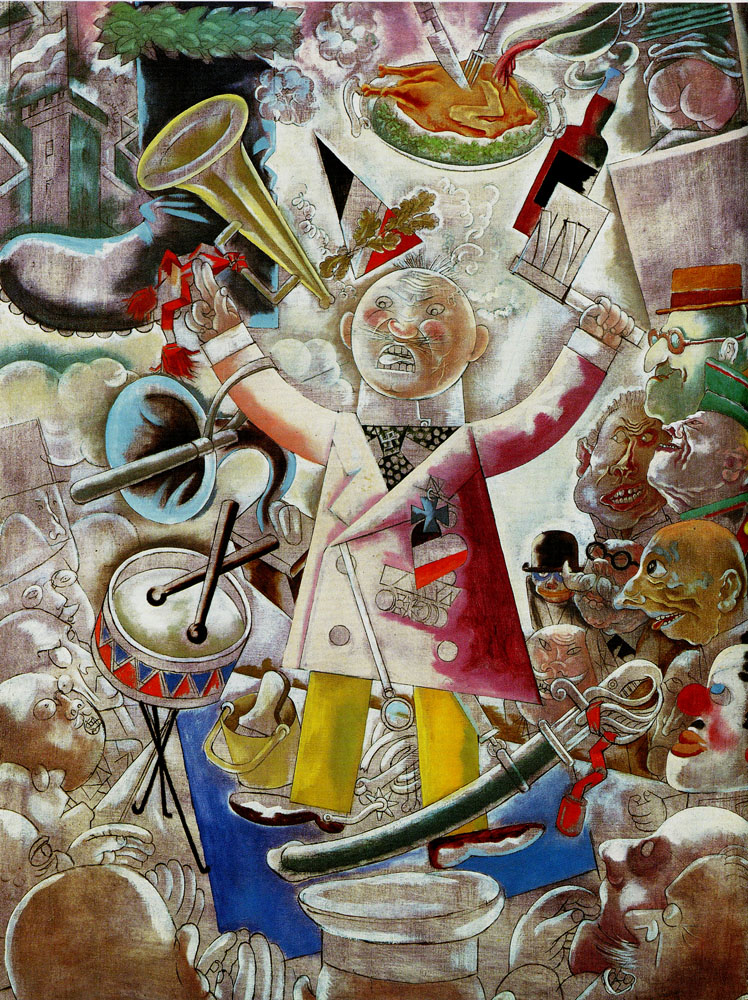
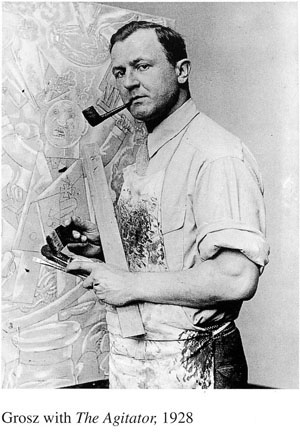
Cover: The Agitator - George Grosz
The career of George Grosz is the perfect example of an artist's
life tied inseparably to the historical, social and political
movements of the age and lived in response to them. Grosz was
born on 26 July 1893 in Berlin, three years after Chancellor
Bismarck's dismissal by Kaiser Wilhelm II. Growing up in the
Kaiser's empire, Grosz volunteered on the outbreak of war in
1914 but in 1915 was discharged, unfit for service; in 1917 he
was called up again, only to be discharged for good soon after.
Following the revolution in Russia, an artists' association,
the "November Group" was established in Berlin in 1918, and
Grosz joined. At the end of that year he became a member of the
Communist Party. In 1919, with the publisher Wieland Herzfelde
(of Malik Publishing), he started a magazine, "Die Pleite"
(roughly: bankruptcy or disaster), and collaborated with Franz
Jung on "Jedermann sein eigener Fuβball" (Everybody his own
football) and with John Hoexter and Carl Einstein on "Der
blutige Ernst" (The bloody seriousness). His drawings, tartly
critical of society, appeared in various Malik publications;
Grosz also produced portfolios and books. In 1921 he was
prosecuted for defamation of the Reichswehr (army); in 1924 for
offences against public morality; in 1928 for blasphemy. In 1924
he became chairman of the artists' association "Rote Gruppe"
(Red Group); until 1927 he was a regular contributor to "Der
Kniippel" (The Stick), a Communist satirical weekly. In 1927 he
supplied drawings to assist Erwin Piscator in his stage
production of "The Good Soldier Schwejk". In 1928 he was
co-founder of the "Association Revolutionarer Bildender
Kiinstler Deutschlands" (German Association of Revolutionary
Artists). In 1932, invited to lecture to the Arts Student
League in New York, Grosz visited the USA, and thfollowing year
emigrated there together with his wife.
Ivo Kranzfelder
|