|
|
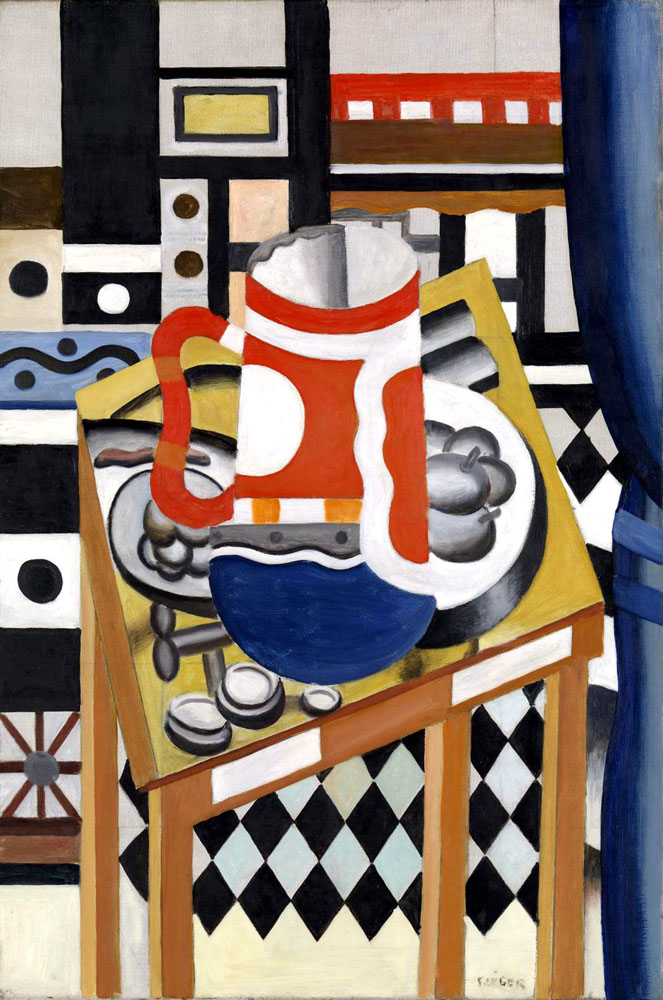
Cover: Still Life with a Beer Mug
Fernand Leger
Deeply affected by his experiences on the front line during the
First World War, Léger abandoned the form of cubism he had been
pursuing up until 1914 and turned instead to what he called a
new ‘reality of objects’ (see Peter de Francia, Fernand Léger,
New Haven and London 1983, p.31). Art historian Robert Herbert
has noted that Léger’s move away from the severe abstraction of
his pre-war compositions and his return to classical subjects
(such as the still life and the nude) was in part connected to a
broader cultural movement in France during the 1920s that has
been called the ‘Return to Order’. ‘By taking up a theme
sanctioned by tradition,’ Herbert notes, Léger ‘hoped to
integrate art history, as well as past time, into the present’
(Robert Herbert, Léger’s Le Grand Déjeuner, exhibition
catalogue, Minneapolis Institute of Arts, Minneapolis 1980,
p.13).
‘The Beautiful is everywhere’, acknowledged Léger in 1924,
‘perhaps [more so] in the arrangement of your saucepans on the
white walls of your kitchen than in your eighteenth-century
living room or in the official museums’ (quoted in Sophie Lévy
(ed.), A Transatlantic Avant-Garde: American Artists in Paris,
1918–1939, Berkeley 2003, p.34).
|