|
|
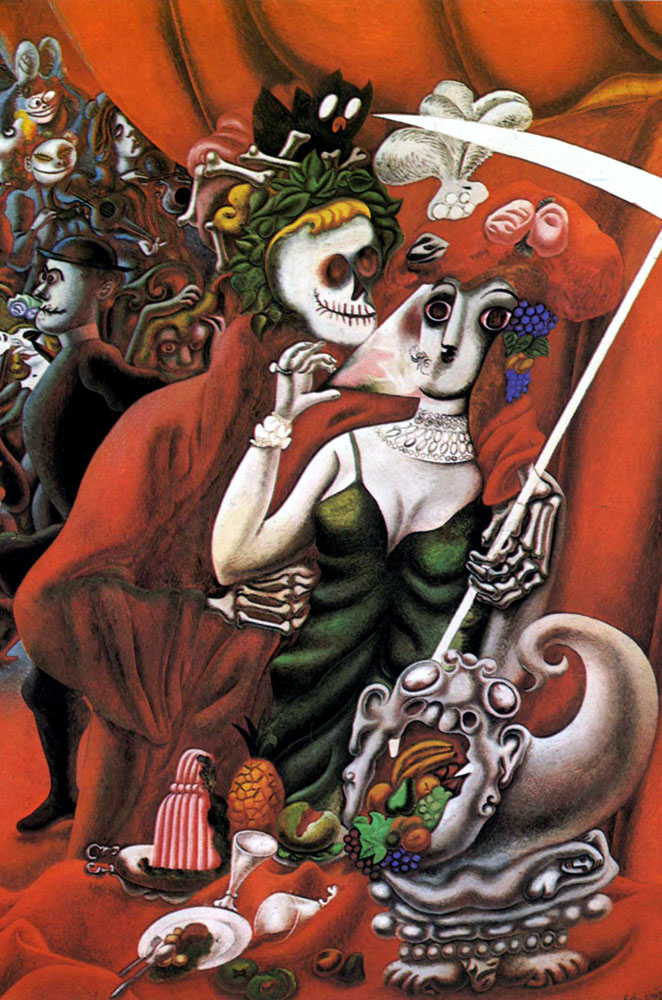
Cover: John Deth
(Homage to Conrad Aiken) 1931
Whitworth Gallery, Manchester
Edward Burra
The Burra
family had origins in Westmorland, being descended from
Robert Burra (1767–1846) of Crosby Ravensworth, who moved
south around 1790. The family prospered and in 1864 Edward’s
grandfather, Henry Burra, after a career in India, bought a
substantial William IV house standing in its own grounds,
‘Springfield’, Playden, very close to Rye. Edward’s father,
also Henry, was a barrister, but had a private income and
like his own father was involved in local government in
Sussex. They were both amateur painters, and Edward’s aunt,
Anne Burra, was married to the architect Reginald Blomfield. Edward
was born in South Kensington in March 1905 in his maternal
grandmother’s house, 31 Elvaston Place, but Rye was his base
for his entire life, from which he made frequent forays to
London, and also to France, Spain, and North America,
notably Harlem and Mexico. His interests were primarily
metropolitan and cosmopolitan. He disliked the conventional
bourgeois values of his parents’ life, but was prevented
from breaking free entirely because of ill health. He ‘had a
little money’. Paul Nash referred to him as the Laird of
Springfield, which he only left in 1953, when his parents
built a new house on the site of a bombed Methodist chapel
in the centre of Rye. He never liked the town, which he
derided as ‘Tinker Belle Towne’, and after the death of his
mother in 1968 he moved to a gardener’s cottage at
Springfield. His sister Anne was very supportive and drove
him around various locations in the British Isles which
feature in landscapes painted after 1965, and she kept an
eye on him until he died in 1976. Edward
boarded at prep school at Potters Bar, but severe arthritis
and anaemia followed by rheumatic fever, prevented him from
going to Eton. He was in pain for much of his life, but
found relief in painting. He was educated privately, with
art lessons from Miss Bradley in Rye, and French lessons in
Kensington. His mother was an important influence, taking
him to Switzerland and Bordighera as a boy. In the library
at Springfield he had access to satirical prints by Hogarth
and Caran d’Ache, and the epic visions of Doré. Aged 15 he
went to the College of Art at the Chelsea Polytechnic,
1921–23. Learning to draw figures at this stage was
fundamental and his skill in architectural drawing was to
feature in later works, but he soon began freer, unshaded
contour drawings. Jazz Fans (Pl 2) and Rue de
Lappe (Pl 3) are good examples.
|